



Choosing between a custom website and a template website may seem like a simple decision at first. But your choice can affect much more than how your website looks. It can influence your website’s performance, SEO, loading speed, user experience, scalability, and even how customers perceive your brand.
That is why the custom website vs template debate is important for almost every business planning to build or redesign its website.
A template can help you get online quickly and keep your initial costs low. A custom website, on the other hand, gives you much more control over the design, functionality, performance, and future growth of your website.
So, which option should you choose?
The answer depends on your business, your budget, your goals, and how important your website will be to your overall marketing strategy. In this guide, we will break down the custom website vs template comparison so you can make a more informed decision.
What Does Custom Website vs Template Actually Mean?
Before we get into the differences, it helps to understand what we mean by custom website vs template.
The two approaches are quite different.
A template website starts with an existing design. You select a theme or template, add your content, replace images, adjust colors, and make other changes within the platform’s options.
A custom website is developed specifically for your business. The design, structure, features, and functionality are created around your requirements instead of adapting your business to an existing template.
When comparing custom website vs template, the biggest difference is essentially flexibility.
A template gives you a starting point.
A custom website gives you a foundation built specifically for your business.
What Is a Custom Website?

A custom website is designed and developed specifically for one business.
Instead of choosing an existing theme and modifying it, developers and designers create the website around your brand, target audience, business objectives, and required features.
A professional Website Development Service may begin with competitor research, audience research, website planning, wireframes, UI design, development, testing, and optimization.
This process generally takes longer than setting up a template website, but it gives you considerably more control.
For example, you can decide exactly how your homepage should work, how visitors move through the website, where calls to action appear, how products or services are presented, and how additional features should function.
This is one of the biggest advantages when looking at custom website vs template options.
What Is a Template Website?
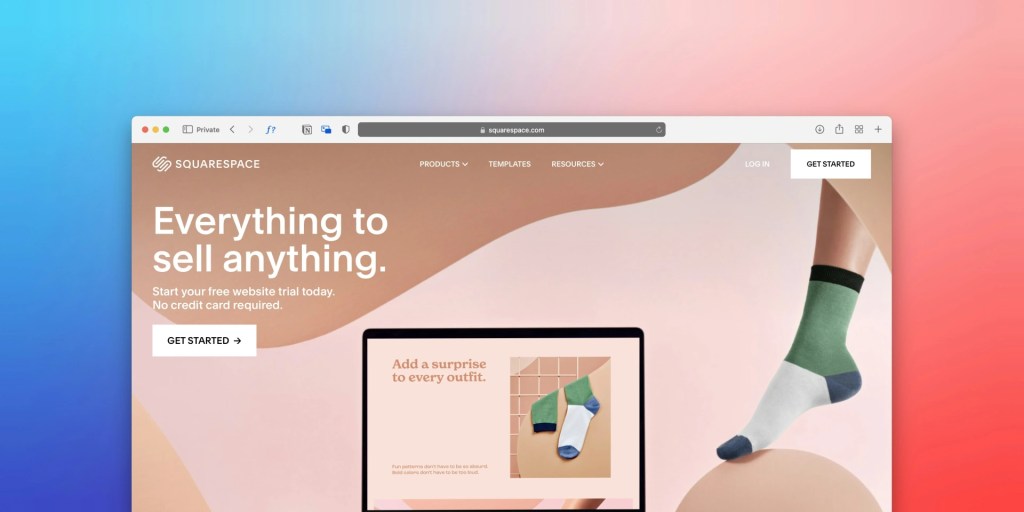
A template website is built using a pre-designed theme or layout.
Platforms such as WordPress, Shopify, and Wix offer thousands of templates that businesses can customize with their own logo, images, text, colors, and branding.
For a small business that simply needs a basic online presence, this can be a practical option.
You can launch faster, spend less initially, and use an existing structure rather than building everything from scratch.
However, there are limitations.
The more you want to change the template, the more you may need plugins, custom development, or design modifications. At a certain point, you may find yourself spending considerable time and money trying to make a template behave like a custom website.
This is where the custom website vs template decision becomes more complicated.
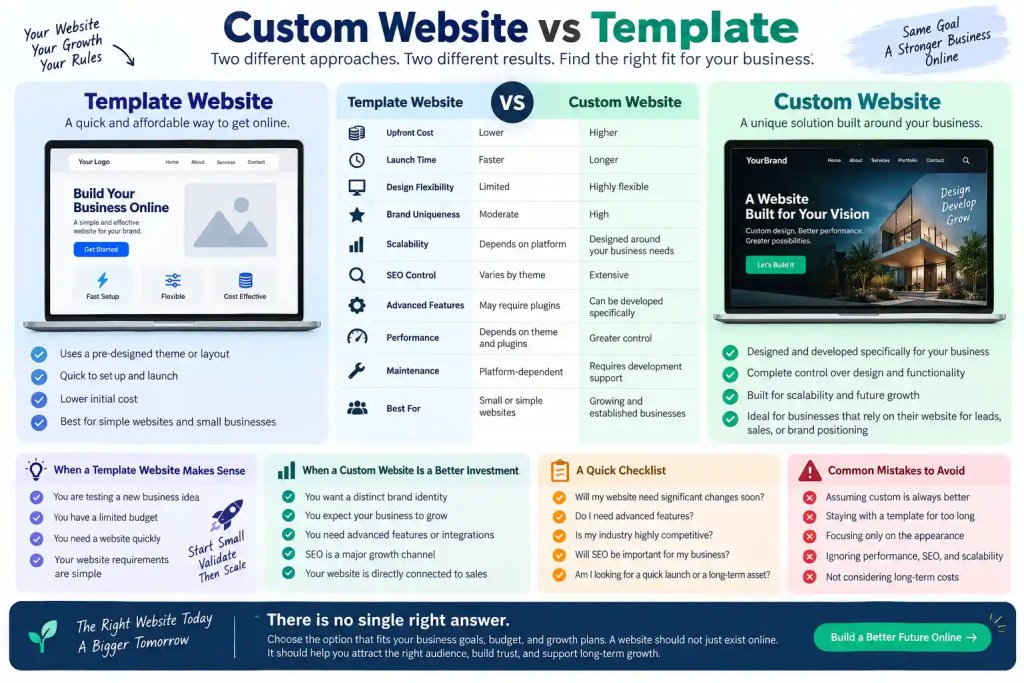
Custom Website vs Template: Key Differences at a Glance

Looking at the custom website vs template comparison side by side can make the decision easier.
| Factor | Template Website | Custom Website |
| Upfront Cost | Lower | Higher |
| Launch Time | Faster | Longer |
| Design Flexibility | Limited by template | Highly flexible |
| Brand Uniqueness | Moderate | High |
| Scalability | Depends on platform | Designed around business needs |
| SEO Control | Varies by theme and platform | Extensive |
| Advanced Features | May require plugins or modifications | Can be developed specifically |
| Performance Control | Depends on theme and plugins | Greater control |
| Maintenance | Often platform-dependent | Requires development support |
| Best For | Small or simple websites | Growing and established businesses |
This table does not mean that one option is automatically better for every business.
The right choice in the custom website vs template discussion depends on what you actually need from your website.
When Does a Template Website Make Sense?
Not every business needs a custom website immediately.
In fact, choosing a template can be a smart decision in certain situations.
1. You Are Testing a New Business Idea
If you are launching a new business or testing a new product, you may not want to invest a large amount of money into a website before knowing how the idea performs.
A template allows you to establish an online presence quickly.
Once the business starts growing, you can consider moving toward a custom website.
2. You Have a Limited Budget
Budget is one of the biggest factors in the custom website vs template discussion.
If your immediate goal is simply to have a professional website online, a template can help you achieve that without a large initial investment.
The money saved can potentially be used for other important areas such as advertising, SEO, content creation, or product development.
3. You Need a Website Quickly
If you need a website within a few days or weeks, a template is generally easier to launch.
You already have the basic structure, so the development process can be much shorter.
For a simple portfolio, small business website, personal website, or basic service website, this can sometimes be enough.
4. Your Website Requirements Are Simple
If your website only needs a few pages such as Home, About, Services, Contact, and Blog, there may not be a strong reason to build everything from scratch.
In these cases, the custom website vs template decision may reasonably favor a template.
When Is a Custom Website a Better Investment?
As your business grows, your website may become much more than an online brochure.
It can become a lead generation system, ecommerce store, booking platform, sales tool, customer portal, or central part of your marketing strategy.
That is when the custom website vs template comparison starts looking different.

1. You Want a Distinct Brand Identity
Your website should look and feel like your business.
A template gives you a predefined structure, which means your website may end up looking similar to many other websites using the same theme.
A custom website allows you to create a completely different visual experience.
Your typography, navigation, animations, layouts, CTAs, product presentation, and overall user journey can be designed specifically around your brand.
For example, your website header can be created around your business goals instead of simply using the layout provided by a theme.
You can also explore ideas to understand how different header structures influence the user experience.
This level of flexibility is one of the main reasons businesses consider custom development when evaluating custom website vs template options.
2. You Expect Your Business to Grow
Think about where your business will be two or three years from now.
Will you add new services?
Will you introduce online bookings?
Will you add memberships?
Will you need customer dashboards?
Will you integrate CRM software?
Will you expand into different markets?
If the answer is yes, choosing a website that can grow with you becomes important.
A template may work perfectly today but become restrictive later.
A custom website can be planned around your expected growth from the beginning.
That makes scalability an important factor in the custom website vs template decision.
3. You Need Advanced Features
Some businesses require functionality that goes beyond standard website features.
For example:
- Custom booking systems
- Membership platforms
- Customer dashboards
- Advanced search
- Custom calculators
- API integrations
- CRM integrations
- Multi-language websites
- Custom ecommerce functionality
- Location-based features
While some templates can support these functions through plugins, plugins can sometimes create additional maintenance and performance requirements.
With a custom website, these features can be developed around your specific requirements.
4. SEO Is a Major Growth Channel
SEO is another important part of the custom website vs template discussion.
Templates are not automatically bad for SEO. A well-built template website can rank successfully.
However, custom development can give developers greater control over technical aspects such as website structure, code, page templates, internal linking, schema implementation, loading performance, and other technical SEO elements.
This becomes particularly useful when your website has hundreds or thousands of pages.
A strong website should also work alongside professional SEO services, rather than relying on design alone to bring organic traffic.
Custom Website vs Template: What Does It Really Cost?
Cost is probably the first thing most business owners consider when comparing custom website vs template.
Template websites generally have lower initial costs.
You may only need to pay for the theme, hosting, plugins, setup, and customization.
A custom website usually costs more because the project involves research, strategy, design, development, testing, optimization, and ongoing technical support.
But there is another side to the calculation.
You should not only ask:
“How much will this website cost today?”
You should also ask:
“How much will this website cost me over the next three to five years?”
A cheap template may eventually require major modifications, a complete redesign, or replacement if the business outgrows its structure.
At the same time, a custom website may require a larger investment upfront but provide a foundation that can support the business for a longer period.
Therefore, when evaluating custom website vs template, look at both the initial cost and the long-term value.
Custom Website vs Template: What About SEO?
SEO deserves special attention because your website structure can influence how easily search engines understand and crawl your website.
A template website can absolutely rank on Google. The fact that a website uses a template does not automatically prevent it from ranking.
However, the level of control can differ.
With a custom website, developers can create page structures specifically around your SEO strategy.
For example, if you have separate services, locations, product categories, and informational content, the website architecture can be planned around those pages from the beginning.
You can also have more control over:
- URL structures
- Internal linking
- Page hierarchy
- Technical elements
- Schema markup
- Image optimization
- Core Web Vitals
- Mobile experience
- Content structure
This is why SEO should be considered carefully when making a custom website vs template decision.
The important thing to remember is that custom development alone does not guarantee rankings.
Good content, technical SEO, backlinks, user experience, search intent, and ongoing optimization still matter.
Custom Website vs Template for Ecommerce Businesses
For ecommerce businesses, the custom website vs template discussion becomes even more important.
Your website is directly connected to the buying experience.
Customers need to be able to browse products, compare options, understand product details, add items to their cart, complete checkout, and trust the brand.
Imagine a premium jewellery brand.
The website needs to communicate quality before a customer even considers purchasing.
Product photography, product pages, filtering, navigation, mobile experience, checkout, and overall design all contribute to that experience.
You can explore resources such as Best Jewellery Website Design Templates for a Luxury Online Store to see how design choices can influence ecommerce presentation.
However, if you need extensive changes to a template, you may eventually spend significant money customizing it.
At that stage, the custom website vs template calculation can become less straightforward.
Custom Website vs Template for Small Businesses in India
For small businesses in India, budget and simplicity are often major considerations.
A local business may not need a highly complex website when it is starting out.
For example, a small salon, restaurant, consultant, local service provider, or freelancer may only need a simple website that communicates:
- Who they are
- What they offer
- Where they are located
- Why customers should choose them
- How customers can contact them
A template may be perfectly suitable for this type of website.
However, businesses operating in competitive markets may need a more distinctive online presence.
A website targeting local searches also needs to consider location pages, Google Business Profile activity, local keywords, reviews, content, and user experience.
Our guide on Best Website Design for Small Business in India explores this topic in more detail.
For businesses looking for Website Development Services in Udaipur, for example, local knowledge can also help when planning website content and local SEO strategies.
Therefore, the custom website vs template decision should consider not just the website itself but also how the website will support your local marketing strategy.
Your Website Should Work With Your Marketing
A website does not operate in isolation.
Even a beautifully designed website will struggle if nobody can find it.
This is why the custom website vs template decision should also be considered alongside your overall marketing plan.
SEO can help bring organic traffic.
Paid advertising can bring targeted visitors.
Social media can help build awareness and engagement.
Content marketing can answer customer questions and establish expertise.
For businesses targeting local customers, SEO Services in Udaipur or services in your target city can help improve visibility for relevant searches.
Similarly, Social Media Marketing Services can help bring users from social platforms to your website.
The website becomes the destination, while your marketing channels help bring people there.
Custom Website vs Template: A Simple Decision Checklist
Still unsure about the custom website vs template choice?
Ask yourself these questions:
- Will my website need significant changes within the next two years?
- Do I need advanced features or integrations?
- Is my industry highly competitive?
- Is brand differentiation important to my business?
- Will SEO be an important source of leads or sales?
- Do I expect my website to handle significantly more traffic in the future?
- Do I need complete control over the user experience?
- Is my website directly connected to sales or lead generation?
- Can my business afford a larger initial investment?
- Am I looking for a quick online presence or a long-term digital asset?
If most of your answers point toward growth, flexibility, and advanced functionality, a custom website may be worth considering.
If your primary requirements are affordability, speed, and simplicity, a template could be a practical starting point.
Common Mistakes Businesses Make
One common mistake in the custom website vs template decision is assuming that custom is always better.
It is not.
If you are testing a business idea and only need a simple website, spending heavily on custom development may not be necessary.
The opposite mistake is staying with a template long after the business has outgrown it.
You may start noticing slow performance, design limitations, plugin conflicts, difficult updates, poor user experience, or restrictions when trying to add new functionality.
Another common mistake is focusing only on the appearance of the website.
A website can look impressive and still generate very few leads.
When comparing custom website vs template, think about the complete experience, including performance, SEO, usability, content, conversion, scalability, and maintenance.
Custom Website vs Template: Which One Should You Choose?

There is no universal answer to the custom website vs template question.
For a new business with a limited budget and simple requirements, a template can be a practical way to get started.
For an established or growing business that depends heavily on its website for leads, sales, bookings, or brand positioning, a custom website can provide considerably more flexibility.
The key is to think beyond the launch date.
Your website should support where your business is going, not just where it is today.
If you expect your business to grow, add new services, target competitive keywords, introduce advanced functionality, or build a stronger digital presence, custom development may make more sense as a long term investment.
If your requirements are straightforward and your priority is getting online quickly, a template can still be a perfectly valid choice.
Ultimately, the best approach to custom website vs template is to evaluate your current needs, plans, budget, marketing strategy, and expected return from the website.
A website should not simply exist online.
It should help your business attract the right audience, build trust, generate enquiries, and support growth.
Frequently Asked Questions
Is a custom website always better than a template?
Not always. For a simple site with low traffic or a business still testing its idea, a template can be the smarter short-term choice. Custom websites tend to win once traffic, revenue, or feature needs grow past what a template platform can comfortably support.
How much more does a custom website cost compared to a template?
Costs vary widely, but a template typically costs a fraction of a custom build upfront. The gap narrows over time when you factor in redesign costs, plugin fees, and lost SEO opportunity on the template side.
Does a template website hurt my SEO?
Not automatically, but templates often include bloated code and generic structures that make strong technical SEO harder to achieve. A custom build gives more direct control over site speed and structure, which supports better long-term rankings.
Can I switch from a template to a custom website later?
Yes. Many businesses launch on a template and move to a custom build once the business model is proven and traffic or feature needs outgrow the platform.
How long does a custom website take to build?
Most custom builds take anywhere from a few weeks to a few months depending on complexity, compared to days or a couple of weeks for a template site.
Is a template site unprofessional?
Not inherently. A well-chosen and well-customized template can look polished for many small businesses. The risk is looking generic or identical to competitors using the same theme.
