


Every business owner reaches the same decision when planning a new website. Do you go with a ready made design that can get your business online quickly, or invest in a website built specifically around your brand and business goals?
That is where the custom vs template website design debate begins.
A template website can be affordable, quick to launch and surprisingly effective for a small business. A custom website, on the other hand, gives you much more control over the design, functionality, performance and future growth of your website.
The right choice depends on more than just the initial price.
Your website influences how people perceive your brand, how easily they navigate your pages, how quickly the site loads, how well it performs in Google Search and how many visitors eventually become enquiries or customers.
In this guide, we will break down custom vs template website design in simple terms. We will compare the costs, timelines, SEO capabilities, performance, scalability, security, ownership and long term benefits of both approaches.
By the end, you should have a much clearer idea of which option makes sense for your business.
What Is a Template Website?
A template website is built using a pre-designed website layout or theme. Instead of designing everything from scratch, you select an existing design and customize it with your own logo, colours, images, content and branding.
Templates are widely available on platforms such as WordPress, Shopify, Wix, Squarespace and Webflow.
There are also thousands of industry-specific templates available through marketplaces such as ThemeForest.
For example, you can find templates specifically designed for restaurants, hotels, real estate companies, jewellery brands, consultants and ecommerce stores.
Most templates come with page builders that allow you to change sections without writing much code.
This makes templates particularly attractive to businesses that want to launch quickly without investing heavily in development.
Where Template Websites Work Well
Templates can be a practical choice for:
- New businesses testing an idea
- Freelancers and consultants
- Personal portfolios
- Small service businesses
- Event websites
- Campaign landing pages
- Small ecommerce stores
- Businesses with straightforward website requirements
For example, if you run a jewellery business and want some design inspiration, browsing Best Jewellery Website Design Templates can help you understand what is already available before deciding whether you need a completely custom solution.
The important thing is to choose a lightweight, well-supported template rather than simply picking the design that looks the most attractive.
What Is a Custom Website?
A custom website is designed and developed specifically for your business.
Instead of starting with a ready-made theme, the design team begins by understanding your brand, audience, competitors, business objectives and conversion goals.
The process can include:
- Business and audience research
- Competitor analysis
- Sitemap planning
- Wireframing
- UX planning
- Custom visual design
- Development
- SEO implementation
- Testing
- Performance optimization
- Launch and support
Designers may use tools such as Figma to create the interface before developers build the final website using a CMS, framework or custom technology stack.
The biggest advantage of custom development is control.
Every page, section, feature and interaction can be created around a specific business requirement.
That level of flexibility is at the heart of the custom vs template website design discussion.
Where Custom Websites Work Well
Custom websites are generally more suitable for:
- Established brands
- Businesses with complex requirements
- Companies that depend heavily on their website for leads
- Ecommerce businesses with unique shopping experiences
- Hotels with advanced booking requirements
- Businesses requiring customer portals
- Brands planning multiple locations or markets
- Companies integrating CRMs, ERPs or other business systems
If your website is going to be an important part of how your business generates revenue, the additional investment in custom development may make more sense.
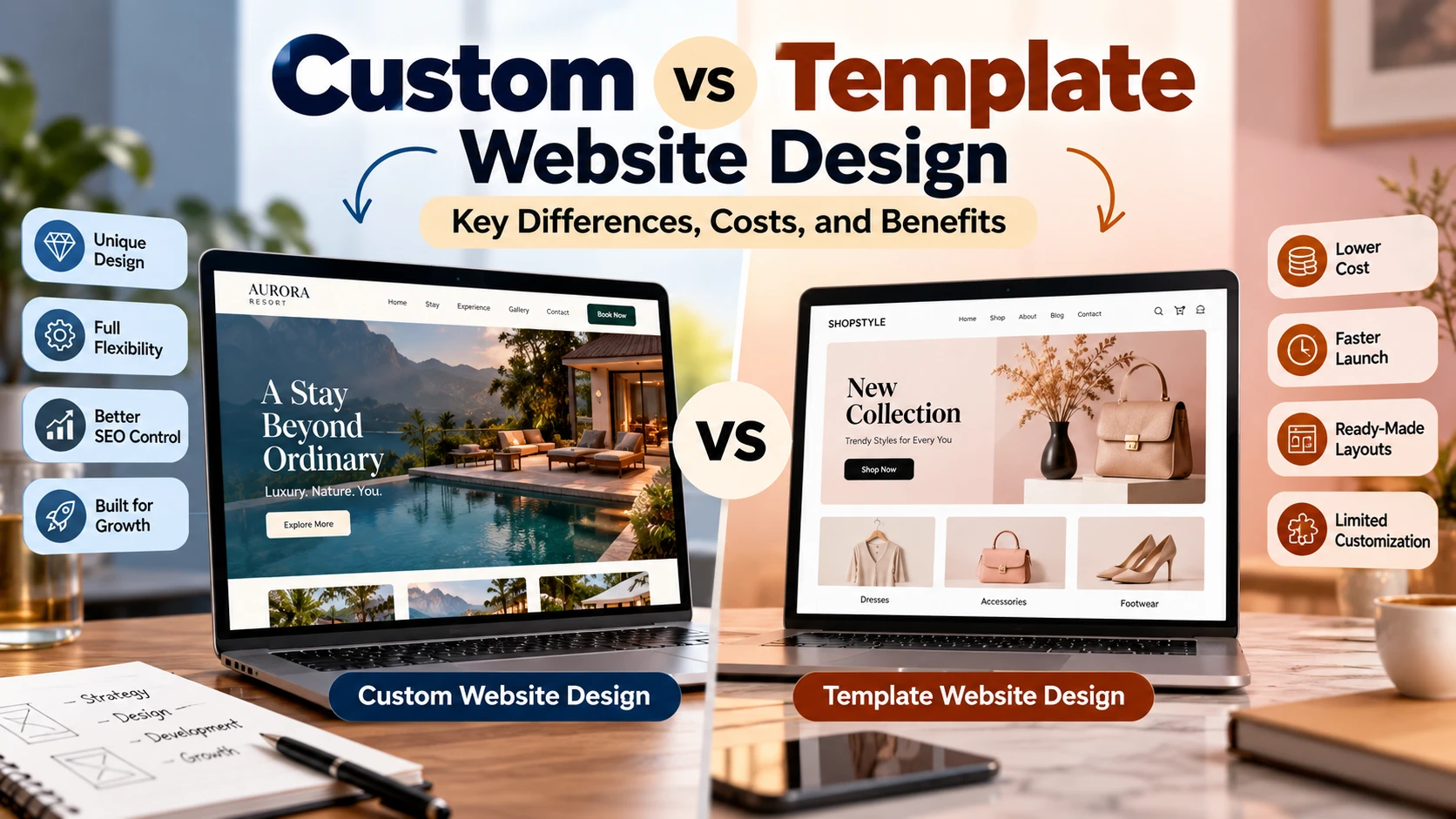
Custom vs Template Website Design: Key Differences at a Glance
Before getting into the details, here is a quick comparison of custom vs template website design.
| Factor | Template Website | Custom Website |
|---|---|---|
| Upfront cost in India | ₹10,000 to ₹50,000 | ₹60,000 to ₹5,00,000+ |
| Launch timeline | 1 to 3 weeks | 6 to 16 weeks |
| Design uniqueness | Based on an existing design | Designed specifically for your brand |
| Performance | Can include unnecessary code | Can be optimized around your requirements |
| SEO control | Depends on the theme and plugins | Greater technical control |
| Scalability | Can be limited by theme structure | Architecture can be planned for growth |
| Integrations | Often plugin-dependent | Built around required systems |
| Maintenance | Theme and plugin updates | Planned development and maintenance |
| Ownership | Depends on theme and platform licensing | Greater ownership and control |
These are general market ranges. Actual costs depend on the number of pages, design complexity, functionality, technology, integrations and development team.
Custom vs Template Website Design: Cost Comparison
Cost is usually the first question businesses ask when considering custom vs template website design.
And there can be a significant difference between the two.
Template Website Costs
A premium website theme can cost anywhere from around ₹3,000 to ₹8,000.
After adding hosting, domain registration, plugins, page builders and development assistance, many small businesses can launch a basic template website within ₹10,000 to ₹50,000.
The initial investment is clearly attractive.
However, remember that a template website can have ongoing costs.
You may need to pay for:
- Premium plugins
- Page builder subscriptions
- Theme renewals
- Security tools
- Hosting upgrades
- Maintenance
- Developer support
Over several years, these smaller expenses can add up.
Custom Website Costs
A custom business website in India can start around ₹60,000 and go significantly higher depending on its requirements.
Large ecommerce websites, portals, booking systems and complex business websites can cost several lakhs.
The investment covers more than just visual design.
You are also paying for research, UX planning, development, testing, performance optimization, SEO structure and technical implementation.
This is why the cost difference should not be judged purely by the initial quotation.
When comparing custom vs template website design, consider the total cost of ownership over several years.
Custom vs Template Website Design: Speed to Launch
If you need a website quickly, templates have an obvious advantage.
Because most of the structure already exists, a skilled developer can customize and launch a template website in a relatively short period.
A simple website may be ready within one to three weeks.
Custom development takes longer because the process includes strategy, wireframes, design approvals, development and testing.
Depending on complexity, six to sixteen weeks can be a realistic timeline.
If your business has a product launch, event or seasonal campaign coming up, the timeline can have a major influence on the custom vs template website design decision.
A template may help you get online immediately, while a custom website may be more suitable when you have time to build something more strategic.
Design and Brand Identity
This is one of the biggest differences between custom and template websites.
Popular templates can be used by thousands of businesses.
Even if you customize the colours, images and logo, the underlying layout may still look familiar.
That can be a problem for brands operating in competitive industries.
A custom website gives your business much more freedom.
The typography, colour palette, navigation, imagery, animations and customer journey can all be designed around your brand.
For premium industries such as luxury hospitality, jewellery and real estate, this can have a direct impact on how customers perceive the business.
Hotels are a good example.
Many hotel owners start by exploring Best Hotel Website Design Templates and later discover that their property needs a more specialized booking journey, room presentation, local storytelling and enquiry flow.
That is where custom development can become valuable.
Performance and Page Speed
Website speed is another important consideration in the custom vs template website design comparison.
Templates are designed to serve a wide range of businesses.
As a result, they may include features you never actually use.
Sliders, animations, extra scripts, font libraries, page builder assets and third party plugins can all add unnecessary weight to a website.
A slower website can affect both user experience and search performance.
Custom websites can be built with only the functionality the business actually needs.
Developers can also optimize the code, images, scripts and page structure around performance requirements.
This does not mean every custom website will automatically be faster.
Poorly developed custom websites can also perform badly.
The quality of development matters.
SEO Capabilities
SEO is one of the most important areas to consider when comparing custom vs template website design.
Template websites can absolutely rank in Google.
Platforms such as WordPress provide access to SEO plugins and tools that can help with titles, descriptions, sitemaps and other basic optimization tasks.
However, you are still working within the limitations of the chosen theme, plugins and platform.
Some templates make it difficult to control:
- Heading structures
- Schema markup
- Internal linking
- URL structures
- JavaScript rendering
- Page templates
- Technical performance
- Site architecture
With custom development, SEO can be considered during the planning stage.
Developers can create cleaner HTML structures, logical URLs, proper heading hierarchies, structured data and an architecture designed around search intent.
A strong technical foundation can then be supported through ongoing SEO work.
For businesses serious about organic growth, this is an important part of the custom vs template website design decision.
Scalability and Flexibility
Your website may look simple today, but what happens two or three years from now?
You may add:
- New products
- New services
- New locations
- Multiple languages
- Customer accounts
- Booking systems
- Payment gateways
- CRM integrations
- Partner portals
- Advanced search functionality
Templates can handle many basic requirements, but their limitations can become more obvious as a business grows.
This is another reason businesses often revisit the custom vs template website design question after a few years.
A custom website can be designed with future requirements in mind.
If you know you are going to expand into multiple cities or countries, for example, the architecture can be planned accordingly from the beginning.
Security and Maintenance
Website security is often overlooked when discussing custom vs template website design.
Template websites commonly rely on multiple plugins.
Each plugin creates another component that needs to be updated and maintained.
If a plugin becomes outdated or unsupported, it can create security or compatibility problems.
A custom website can reduce reliance on unnecessary third party plugins.
However, custom development does not mean maintenance is unnecessary.
Every website needs:
- Security updates
- Backups
- Performance monitoring
- Software updates
- Bug fixes
- Security checks
- Regular technical audits
The difference is that custom development gives you more control over what is included in the website.
Ownership and Control
Ownership is another factor that businesses should consider.
With a template website, you are often working with a theme, page builder or platform that has its own licensing and technical limitations.
Some page builders can also make migration difficult if you decide to move away from them.
A custom website gives you greater control over the design and development assets.
Before starting any project, make sure your business owns or has appropriate access to:
- Domain
- Hosting account
- Website files
- Design files
- Content
- Images
- Database
- Analytics accounts
- Search Console property
This can save you significant trouble if you change developers or agencies later.
Pros and Cons of Template Website Design
Pros
- Lower initial investment
- Faster launch
- Easy to customize
- Large support communities
- Many ready-made designs available
- Suitable for simple business websites
- Good option for testing an idea
Cons
- Limited uniqueness
- Potentially unnecessary code
- Theme-dependent SEO flexibility
- Plugin dependency
- Ongoing subscription costs
- More difficult customization for complex requirements
Pros and Cons of Custom Website Design
Pros
- Completely unique design
- Greater branding flexibility
- More control over performance
- Stronger technical SEO flexibility
- Easier integration with business systems
- Better scalability
- Greater control over functionality
- More ownership of the final product
Cons
- Higher initial investment
- Longer development timeline
- Requires experienced developers
- Needs proper planning
- Ongoing maintenance is still required
How to Choose Between Custom vs Template Website Design
There is no universal answer in the custom vs template website design debate.
The right choice depends on your business, budget, timeline and plans.
Ask yourself the following questions.
What Role Does Your Website Play?
If the website is simply an online brochure, a template may be enough.
If the website generates leads, bookings or sales every day, investing in a more customized solution may make more sense.
What Is Your Realistic Budget?
Do not look only at the launch price.
Consider hosting, plugins, maintenance, redesigns and future development as well.
How Quickly Do You Need to Launch?
If you need to launch within a couple of weeks, a template can help.
If you have several months and want to build a long term digital asset, custom development becomes more attractive.
How Competitive Is Your Industry?
In a crowded industry, your website needs to stand apart.
A unique design can help create a stronger brand experience and build trust.
Do You Need Special Features?
Booking systems, calculators, customer portals, advanced ecommerce features and complex integrations often point towards custom development.
What Are Your Growth Plans?
If you expect your business to expand significantly, consider whether your current website can handle that growth.
This is where custom vs template website design becomes more than a design decision. It becomes a technology and business strategy decision.
When a Template Website Is the Smarter Choice
A template may be the right option if:
- You are launching a new business
- Your budget is limited
- You need a website quickly
- You only need a few pages
- Your functionality requirements are simple
- You are still testing your business model
- Organic search is not yet a major acquisition channel
There is nothing wrong with starting with a template.
The important thing is to choose one that gives you enough flexibility for your current needs.
When Custom Design Is Worth the Investment
Custom development can be worth considering when:
- Your website generates significant revenue
- Your brand needs a distinctive online identity
- SEO is an important growth channel
- You need advanced functionality
- You require multiple integrations
- You expect significant business growth
- You want greater technical control
- You want to avoid rebuilding the website in the near future
In these situations, the higher initial investment can be easier to justify.
The Middle Ground: Customized Templates
The custom vs template website design decision does not always have to be completely one or the other.
There is a middle option.
You can start with a high-quality template and customize it extensively.
A developer can modify layouts, remove unnecessary features, improve performance and add specific functionality.
This approach can give you more flexibility without the full cost of building everything from scratch.
However, the foundation matters.
Choose a lightweight and well-maintained theme.
A poorly structured template can become difficult to customize later, even if you initially save money.
Custom vs Template Website Design for Local Businesses in Udaipur
For businesses in Udaipur, the custom vs template website design decision can be particularly relevant.
The local market includes hospitality, tourism, jewellery, handicrafts, education, restaurants and professional services.
These are industries where visuals, trust and first impressions matter.
Consider a heritage hotel near Lake Pichola.
The website needs more than beautiful photographs. It may need room galleries, booking functionality, enquiry forms, location information, local experiences and a smooth mobile experience.
Similarly, a jewellery brand targeting customers outside Udaipur may need a premium website that builds trust with visitors who have never interacted with the business before.
For businesses with these requirements, working with a team that provides Website Development Services in Udaipur can help combine local market knowledge with professional website strategy.
Smaller businesses such as cafes, coaching centres and local service providers may not need that level of customization immediately.
For them, a well-selected template can be a sensible starting point.
Common Mistakes to Avoid
Regardless of where you stand in the custom vs template website design decision, avoid these common mistakes.
Choosing Only on Price
The cheapest website is not always the most affordable option in the long run.
A website that needs to be rebuilt after two years can cost more than making the right investment initially.
Ignoring Mobile Users
A large amount of website traffic comes from mobile devices.
Test your website on different screen sizes before launch.
Installing Too Many Plugins
Every additional plugin can add complexity, maintenance requirements and potential security risks.
Only install what you actually need.
Ignoring SEO Until After Launch
SEO should not be an afterthought.
Site architecture, URLs, headings, internal links and technical performance should be considered before development is complete.
Not Owning Your Website Assets
Make sure your business owns the domain and has access to hosting, analytics, Search Console and other important accounts.
Why Your Website Choice Affects Long-Term Marketing ROI
Your website is often the centre of your digital marketing ecosystem.
Google Ads sends traffic to it.
Meta Ads sends traffic to it.
SEO sends traffic to it.
Social media, email campaigns and referrals can also send visitors to the same website.
If the website is slow, confusing or difficult to navigate, every marketing channel can become less effective.
For example, you could spend ₹50,000 on advertising and generate thousands of visitors, but if the landing page does not communicate the offer clearly, a large percentage of those visitors may leave without enquiring.
A better website can improve the overall customer journey.
This is why the custom vs template website design discussion should not be limited to development costs.
Think about the website as a long term marketing asset.
If you invest heavily in SEO, Google Ads or social media advertising, your website needs to be capable of converting the traffic those channels generate.
For local businesses, visibility matters too. Investing in SEO Services in Udaipur can help ensure that the website you build is actually discovered by customers searching for your products or services.
Custom vs Template Website Design: Final Thoughts
The custom vs template website design decision ultimately comes down to your current business needs and future plans.
A template website can be an excellent option when you need something affordable, fast and relatively simple.
A custom website makes more sense when your website plays a major role in revenue generation, branding, SEO or customer experience.
The important thing is not to choose custom simply because it sounds more premium, or choose a template simply because it costs less.
Look at your budget, timeline, business goals, functionality requirements and growth plans.
If you are still testing your business idea, a good template may give you everything you need.
If your website is already a major part of your business and you expect that role to grow, custom development may provide the flexibility you need.
Ultimately, custom vs template website design is not about choosing the most expensive option. It is about choosing the solution that gives your business the right balance of cost, performance, flexibility, branding and long term value.
If you are still unsure about custom vs template website design, review your goals, competitors and expected growth before making a decision.
A good development partner can also help you understand what you actually need instead of simply recommending the more expensive option.
The right website should not just look good.
It should support your marketing, make it easy for customers to take action, perform well across devices and give your business room to grow.
Infographic: Custom vs Template Website Design Infographic.png
Frequently Asked Questions
What is the main difference in custom vs template website design?
The main difference is how the site is built. A template website uses a prebuilt layout that you customise with your own content, while a custom website is designed and coded from scratch for your business. Templates are cheaper and faster to launch. Custom sites offer unique branding, better performance, deeper SEO control and easier scaling over time.
Is a custom website better for SEO than a template?
In most cases, yes. A custom website lets developers write clean code, set proper heading structures, add schema markup and optimise page speed from the start. Template sites can still rank well with good content and plugins, but theme limitations and extra code can hold back technical SEO and Core Web Vitals scores.
How much does a custom website cost in India?
A custom business website in India usually costs between ₹60,000 and ₹2,00,000 for a standard corporate site. Ecommerce stores, booking platforms and portals with advanced features can cost ₹3,00,000 to ₹5,00,000 or more. The final price depends on the number of pages, design complexity, integrations and ongoing support requirements.
How long does it take to build a custom website?
Most custom websites take six to sixteen weeks from discovery to launch. Simple business sites sit at the shorter end, while ecommerce stores and complex platforms take longer. The timeline also depends on how quickly content is ready and how fast feedback and approvals move between the business and the design team.
Can I start with a template and switch to custom later?
Yes, and many businesses do exactly that. Starting with a template lets you get online quickly and validate demand. Once traffic and revenue grow, you can invest in a custom build. Plan your URL structure carefully from the beginning and use proper redirects during migration to protect your search rankings.
Are template websites safe to use?
Template websites are safe when you choose a reputable, regularly updated theme and keep plugins to a minimum. Risks rise when themes or plugins are abandoned by their developers or downloaded from unofficial sources. Regular updates, strong passwords, backups and a security plugin go a long way in keeping a template site protected.
Which is better for a small business, custom or template?
For a small business with a tight budget and simple needs, a template is often the practical starting point. If your website is your main source of leads, or you work in a competitive or premium industry, a custom website usually delivers better returns. Base the choice on goals and growth plans, not just the launch price.
Do custom websites need more maintenance?
Custom websites need regular maintenance, but often less firefighting than plugin-heavy template sites. Because they rely on fewer third-party tools, there are fewer updates and compatibility issues. Most businesses sign an annual support plan with their developer covering security updates, backups, minor changes and performance checks.