


If you have spent even ten minutes searching for the right technology stack, you already know the list feels endless. New frameworks show up every few months, older languages keep reinventing themselves, and every developer online seems to have a strong opinion about what you should learn next.
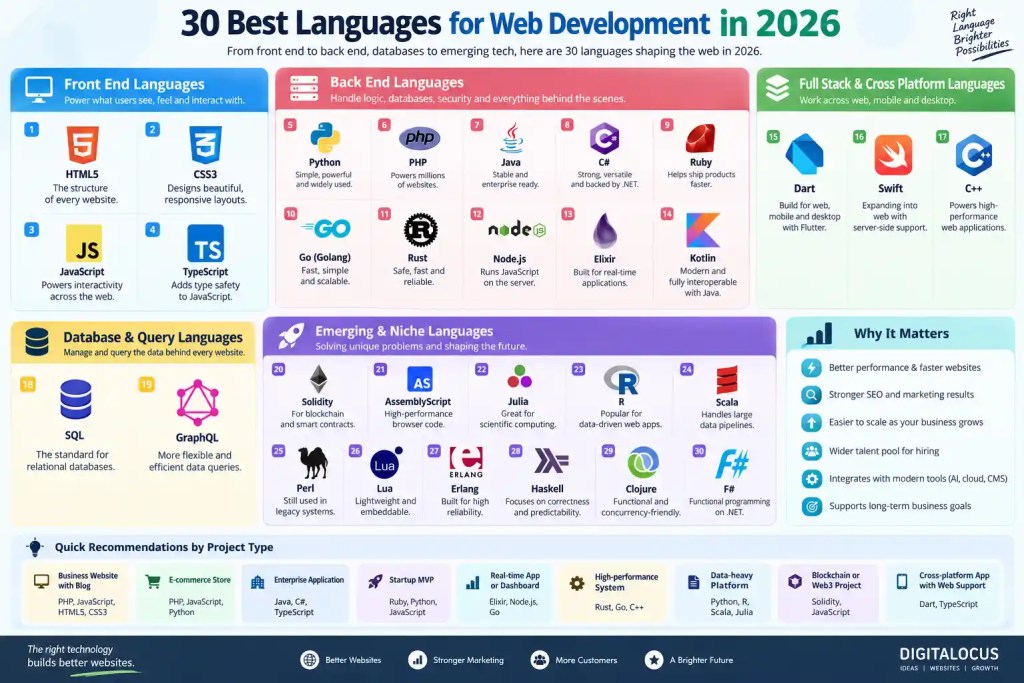
This guide is our attempt at cutting through that noise with a practical, well-researched rundown of the 30 best languages for web development in 2026. We have organized everything by what each language actually does: front end, back end, full stack, databases, and a handful of emerging picks that are worth watching. Whether you are a business owner planning a new website, a student choosing what to learn, or a hiring manager building a tech team, this list will help you understand where each language fits and why it made the cut.
At Digitalocus, we work with these languages every day while building and optimizing client websites, so this list is shaped by real project experience, not just theory.
What Makes a Language One of the Best Languages for Web Development in 2026
Before jumping into the list, it helps to understand the criteria we used. Community support matters a lot, since a large, active community means better documentation, more tutorials, and faster bug fixes.
Performance matters too, especially as websites handle more real-time data, AI features, and heavier traffic. Ease of learning affects how quickly a team can onboard new developers, and job market demand tells you whether a language will stay relevant for the next few years. We also looked at how well each language plays with modern tools like cloud hosting, headless CMS platforms, and AI-assisted coding.

Front End Languages Among the 30 Best Languages for Web Development in 2026
Front-end languages control what users see and how they interact with a page. These four are non-negotiable entries on this list.
HTML5
HTML5 is the skeleton of every website on the internet. It defines structure, headings, forms, images, and semantic elements that help search engines and screen readers understand a page. Every business that wants strong SEO services needs a site built on clean, semantic HTML, because search engines read structure before they read design.
CSS3
CSS3 handles the visual layer, colors, spacing, animations, and responsive layouts that adjust to phones, tablets, and desktops. With features like Grid, Flexbox, and container queries now standard, CSS3 lets designers build polished interfaces without relying on heavy frameworks. A site with strong CSS also tends to perform better in Core Web Vitals, which ties directly into ranking.
JavaScript
JavaScript remains the single most widely used programming language for the web. It runs in every browser, powers interactive elements, and through Node.js, now runs on servers too. Its flexibility is exactly why it consistently sits near the top of any list of the best languages for web development in 2026. From simple form validation to complex single-page applications, JavaScript touches nearly every website you visit.

TypeScript
TypeScript adds static typing on top of JavaScript, which catches errors before code ever reaches production. Large teams love it because it makes big codebases easier to maintain and refactor safely, and adoption has grown quickly enough that it belongs on any serious shortlist for a new project expected to scale.
Back End Languages Among the 30 Best Languages for Web Development in 2026
Back-end languages handle logic, databases, authentication, and everything happening behind the scenes, and several of them consistently rank among the best languages for web development in 2026 for scalability and long-term reliability.
Python
Python’s clean, readable syntax makes it a favorite for startups and enterprises alike. Frameworks like Django and FastAPI let developers build secure, scalable web applications quickly, and Python’s dominance in AI and data science means it integrates smoothly with machine learning features that more websites are adding in 2026.
PHP
PHP still powers a huge share of the internet, largely thanks to WordPress and other content management systems. Modern PHP, especially with Laravel, is fast, secure, and well suited for business websites, e-commerce stores, and content-heavy platforms that need a reliable Website Development Service behind them.
Java
Java remains the backbone of many large enterprise systems. Its stability, strong typing, and mature ecosystem make it a dependable choice for banking platforms, logistics systems, and any web application that needs to run reliably for years without major rewrites.
C# and .NET
C# paired with the .NET platform is a strong choice for businesses already invested in Microsoft’s ecosystem. It handles everything from internal business tools to public-facing e-commerce platforms, with solid performance and deep integration with Azure cloud services.
Ruby
Ruby, especially through Ruby on Rails, is known for helping small teams ship products fast. Startups often choose Ruby when speed to market matters more than squeezing out every millisecond of performance, and its convention over configuration approach keeps codebases tidy.
Go (Golang)
Go was built by Google for speed and simplicity. It compiles fast, runs fast, and handles concurrent requests extremely well, which is why so many cloud native tools and microservices are written in Go.
Rust
Rust has earned a loyal following for its memory safety guarantees without sacrificing raw performance. It has a steeper learning curve than most languages on this list, but for web platforms where security and speed cannot be compromised, Rust is becoming one of the best languages for web development in 2026, particularly for backend services and WebAssembly modules.
Node.js
Technically a runtime rather than a separate language, Node.js lets developers use JavaScript on the server, which means one language can power both the front end and back end of a project. This full stack simplicity is a major reason JavaScript and Node.js together dominate so many modern tech stacks.
Elixir
Built on the Erlang virtual machine, Elixir is designed for applications that need to handle massive numbers of simultaneous connections think chat apps, real-time dashboards, and live notification systems. Its fault-tolerant design makes it a smart pick for platforms that cannot afford downtime.
Kotlin
Originally known for Android development, Kotlin has expanded into server side web development through frameworks like Ktor. Its interoperability with Java means teams can adopt it gradually, and it has quietly become one of the best languages for web development in 2026 for teams that already run on the Java virtual machine.
Full Stack and Cross Platform Languages Shaping the Best Languages for Web Development in 2026 List
Some languages blur the line between platforms, letting teams share code across web, mobile, and desktop.
Dart
Dart, paired with the Flutter framework, was originally built for mobile apps but now supports web and desktop targets from a single codebase. Businesses that want one team building for multiple platforms often turn to Dart, and it comes up often when local teams offering Website Development Services in Udaipur need to ship a website and an app together on a tight timeline.

Swift
Apple’s Swift language is best known for iOS development, but SwiftWasm and server side frameworks like Vapor have opened the door to Swift powered web backends, appealing to teams already fluent in the Apple ecosystem.
C++
C++ is not the first language most people associate with the web, but it plays an important role through WebAssembly, powering performance-heavy browser applications like video editors, games, and design tools that need near native speed.
Database and Query Languages Every Developer Should Know
A website is only as good as the data behind it, which is why database languages belong on any serious list of the best languages for web development in 2026.
SQL
SQL remains the standard for relational databases. Whether you are running MySQL, PostgreSQL, or SQL Server, understanding SQL is essential for building websites that manage products, users, orders, and analytics data efficiently.
GraphQL
GraphQL gives front-end teams precise control over the data they request from an API, reducing over-fetching and speeding up applications. Many modern web platforms now expose GraphQL endpoints alongside or instead of traditional REST APIs, and its rise is one of the more interesting shifts among the best languages for web development in 2026.
Emerging and Niche Languages Worth Watching in 2026
These languages are not always the first choice for a typical business website, but they solve specific problems well and round out this list.
Solidity
Solidity is the primary language for writing smart contracts on Ethereum and similar blockchains. As more businesses experiment with web3 features, decentralized payments, and NFT storefronts, Solidity knowledge is becoming a valuable niche skill, though those storefronts still rely on solid Commercial Shoot & Production Services to make the products behind the contracts look worth buying.
AssemblyScript
AssemblyScript brings TypeScript-like syntax to WebAssembly, letting JavaScript developers write high-performance browser code without learning an entirely new language ecosystem.
Julia
Julia was built for numerical computing and is gaining traction in web applications that need heavy data processing, scientific dashboards, and real-time analytics baked directly into the front end.
R
R remains a favorite among data scientists, and with tools like Shiny, it can power interactive, data-driven web dashboards without requiring a traditional JavaScript front end.
Scala
Scala runs on the Java Virtual Machine and combines object-oriented and functional programming. Companies handling massive data pipelines often pair Scala with tools like Apache Spark for web platforms that process huge datasets in real time.
Perl
Perl has been around since the early days of the web and still shows up in legacy systems and text processing tasks. It is not a common choice for new projects, but plenty of established platforms still rely on it.
Lua
Lua is lightweight and embeddable, often used for scripting within larger web applications, game engines, and configuration systems where a small, fast interpreter is needed.
Erlang
Erlang, the foundation Elixir is built on, remains a strong choice on its own for telecom systems, messaging platforms, and any web service that demands near-perfect uptime.
Haskell
Haskell’s strict functional approach appeals to teams that prioritize correctness and predictability, and it is increasingly used for backend services where bugs simply cannot slip through.
Clojure
Clojure brings functional programming to the Java Virtual Machine with a Lisp-inspired syntax, favored by teams that want immutable data structures and simpler concurrency handling in their web backends.
F#
F# is Microsoft’s functional-first language on the .NET platform, popular with teams that want functional programming benefits while staying inside the .NET and C# ecosystem.
How to Choose the Right Language for Your Web Project
With 30 options on the table, picking one can feel overwhelming, so start with your project goals rather than the hype around any single language. A content-heavy business site with an active blog often does well with PHP or a JavaScript-based stack, paired with strong SEO services to make sure the content actually ranks. A data-intensive platform might lean toward Python or Go, while a real-time application with thousands of concurrent users could benefit from Elixir or Node.js.
Team skill and hiring availability matter just as much as technical merit. JavaScript, Python, and PHP have huge talent pools, which keeps hiring and maintenance costs manageable, while niche languages like Rust or Solidity offer real advantages but come with a smaller pool of experienced developers. Budget and timeline also play a role. Ruby and PHP are known for fast development cycles, while Java and C# tend to favor long-term stability over quick iteration. When you weigh these factors together, the best languages for web development in 2026 for your project become much easier to spot.
It also helps to think past launch day. A codebase that supports clean analytics and tracking makes life much easier for whichever Performance Marketing Service ends up running your campaigns once the site goes live.

Why the Right Language Choice Affects Your Marketing Results Too
Choosing the right technology stack is not only a technical decision, it directly affects your marketing performance. A slow, poorly coded site hurts your search rankings no matter how good your SEO Services in Udaipur strategy is, since crawlers and visitors both judge a page on how fast it loads.
A fast, well-built website also makes every other part of your digital strategy work harder. Page speed and clean code feed directly into how well a Performance Marketing Services in Udaipur campaign converts paid clicks into actual customers, because no amount of ad spend fixes a checkout page that loads slowly.
The same logic applies to content. A brand posting regularly through Social Media Marketing Services in Udaipur still needs somewhere fast and reliable to send that traffic, because a beautifully shot reel or post loses most of its value if it lands on a page that stalls or looks broken on a phone. The language behind your site is the foundation everything else stands on.

Best Languages for Web Development in 2026 by Use Case
Here is a quick reference table matching common project types to the right technology for that specific need.
| Project Type | Recommended Languages |
| Business website with blog | PHP, JavaScript, HTML5, CSS3 |
| E-commerce store | PHP, JavaScript, Python |
| Enterprise application | Java, C#, TypeScript |
| Startup MVP | Ruby, Python, JavaScript |
| Real-time app or dashboard | Elixir, Node.js, Go |
| High-performance system | Rust, Go, C++ |
| Data-heavy platform | Python, R, Scala, Julia |
| Blockchain or web3 project | Solidity, JavaScript |
| Cross-platform app with web support | Dart, TypeScript |
Whatever you land on, the stack and the marketing plan need to move together. A site built for speed gives Social Media Marketing Services something worth linking to, instead of traffic that bounces off a slow page.

Conclusion
Choosing from the 30 best languages for web development in 2026 does not have to be complicated once you understand what each one is actually built for. Front-end languages like HTML5, CSS3, JavaScript, and TypeScript shape what users see. Back-end languages like Python, PHP, Java, Go, and Rust handle the logic and data behind the scenes. Niche picks like Solidity, Julia, and Elixir solve very specific problems for teams that need them.
None of this is about chasing trends. It is about matching the right tool to the right project, team, and budget. Whether you are planning a full site rebuild or launching something brand new, the technology decisions you make now will shape how your website performs for years to come.
If you would rather leave these decisions to a team that builds and optimizes websites every day, Digitalocus can help. We work with local businesses that need strong Commercial Shoot & Production Services in Udaipur alongside a site built to actually put that content to work, and that combination- technology plus the marketing behind it, is where real results come from.
Read: Best Programming Languages for Web Development in 2026
Frequently Asked Questions
What are the 30 best languages for web development in 2026?
The 30 best languages for web development in 2026 span front-end, back-end, and specialized use cases. They include HTML5, CSS3, JavaScript, TypeScript, Python, PHP, Java, C#, Ruby, Go, Rust, Node.js, Elixir, Kotlin, Dart, Swift, C++, SQL, GraphQL, Solidity, AssemblyScript, Julia, R, Scala, Perl, Lua, Erlang, Haskell, Clojure, and F#.
Which language should a beginner learn first for web development in 2026?
Most beginners start with HTML5 and CSS3 to understand structure and styling, then move on to JavaScript, since it works on both the front end and the back end and has one of the largest learning communities of any language on this list.
Is Python good for web development in 2026?
Yes, Python is one of the best languages for web development in 2026, especially for projects that need to integrate AI features, data processing, or rapid backend development through frameworks like Django and FastAPI.
Is PHP still relevant in 2026?
PHP is still very relevant, particularly for content management systems, WordPress sites, and business websites that need a reliable Website Development Service behind them. Modern PHP with Laravel is fast and secure.
What is the best language for a fast, scalable backend?
Go and Rust are frequently recommended for fast, scalable backends because both handle heavy traffic efficiently while keeping server costs down, which is part of why they show up so often on lists of the best languages for web development in 2026 for high-traffic platforms.
Do I need to learn all 30 languages to build websites?
No. Most professional developers specialize in two or three languages that cover front end, back end, and databases. This guide to the best languages for web development in 2026 is meant as a map of the landscape, not a checklist to complete.
Which language is best for e-commerce websites?
PHP, JavaScript, and Python are the most common choices for e-commerce platforms in 2026, each offering strong plugin ecosystems, payment gateway support, and scalability for growing online stores.
How does the right programming language affect SEO?
The language and framework behind a site directly affect page speed, mobile performance, and code cleanliness, all of which influence how well SEO services can help a site rank. A technically sound foundation gives an SEO strategy much more to work with.
