




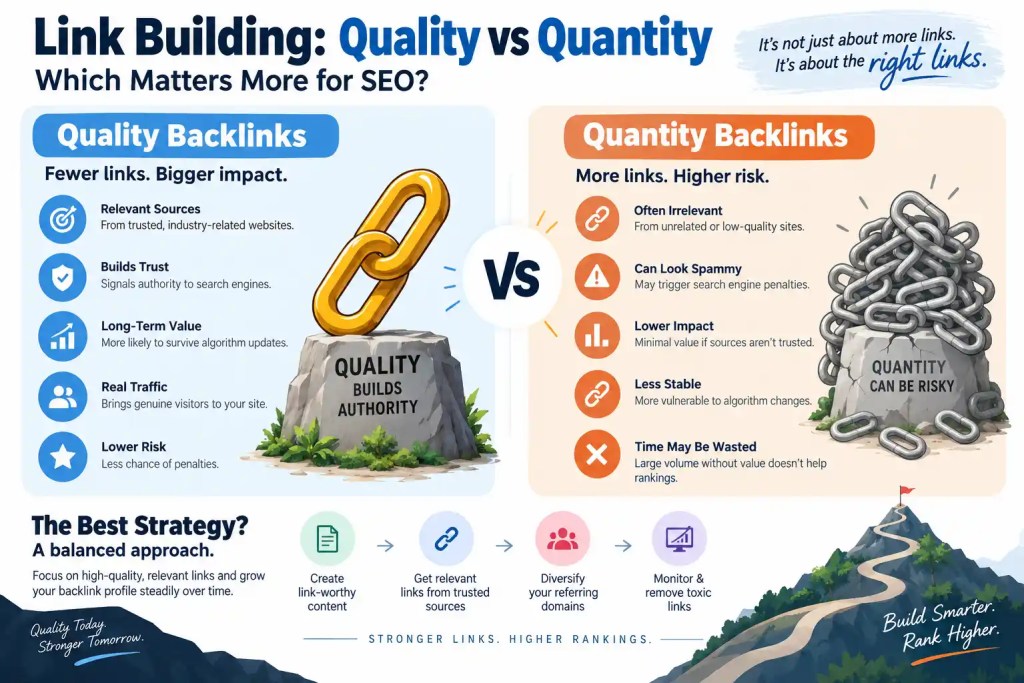
If you have spent any time researching SEO, you have probably landed in the middle of a heated debate. Some people swear by chasing as many backlinks as possible. Others say one good link is worth more than a hundred average ones. So which side is right? This is the best link building quality vs quantity question almost every website owner asks sooner or later, and honestly, it deserves a clear answer rather than confusion.
In this blog, we are going to break down what quality and quantity actually mean in link building, look at what search engines really reward in 2026, and help you figure out the best link building quality vs quantity strategy for your own website. Whether you run a small local business or manage SEO for a growing brand, this guide will help you stop guessing and start building links that actually move the needle.
A quick search on Reddit shows this debate is very much alive among real marketers too. One popular thread asked, “When it comes to backlinks, do you focus more on quantity or quality? What strategy has worked best for you?” The person asking had been in the quality over quantity camp for a while but had also seen people get results from higher link volume. That mixed experience is exactly why this topic keeps coming up, and why understanding the best link building quality vs quantity balance matters so much.
What Do Quality and Quantity Actually Mean in Link Building?

Before picking a side, it helps to define the terms properly. A lot of confusion around the best link building quality vs quantity debate comes from people using these words loosely without agreeing on what they mean.
What Makes a Backlink High Quality?
A high-quality backlink usually comes from a website that is trusted, relevant to your industry, and has real readers or visitors. It is not just about a high domain rating number. Quality also depends on where the link sits on the page, whether it is placed naturally inside useful content, and whether the linking site would actually send a real person to click it.
A few traits of a strong backlink include relevance to your niche, editorial placement inside the body content rather than a footer or sidebar, traffic that the linking site actually receives, and a general reputation for trustworthy, well-researched content. When people talk about the best link building quality vs quantity approach, this is usually the “quality” side they mean.
What Counts as Quantity in a Backlink Profile?
Quantity simply refers to the total number of backlinks pointing to your website, regardless of where they come from. In the early days of SEO, quantity alone could push a site up the rankings. Marketers built thousands of links through directories, forums, and link farms, and it worked, at least for a while.
That is no longer the case. Search engines got smarter, and today raw volume without relevance or trust can actually hurt more than it helps. This is a big part of why the best link building quality vs quantity conversation has shifted so heavily toward quality in recent years.
The Best Link Building Quality vs Quantity Debate: What Does the Data Actually Show?
Numbers help settle arguments, so let’s look at what the data says. Backlink research has repeatedly found that top-ranking pages tend to have more backlinks on average than pages sitting further down the results. One widely cited study found that the top-ranking page had close to four times as many backlinks as pages ranked between second and tenth place.
At first glance, that sounds like a win for quantity. But dig a little deeper and the picture changes. The same research, and plenty of case studies since, show that domain diversity and link relevance matter far more than sheer count. In other words, ten backlinks from ten different reputable, relevant websites will usually outperform a hundred links dumped from low-quality or unrelated sites. This is really the heart of the best link building quality vs quantity question. It is not simply about having more links. It is about having the right links, and enough of them to signal genuine authority.
Ten strong, relevant backlinks from trusted sites will almost always outperform a thousand spammy ones. At the same time, a single quality link rarely does all the heavy lifting either. Most sites that rank well have built a healthy volume of quality links over time, which is why the smartest approach blends both ideas rather than picking an extreme.
Why Most SEO Professionals Lean Toward Quality Today
Ask any experienced SEO consultant about the best link building quality vs quantity approach, and most will tell you quality wins in 2026. There are solid reasons behind that opinion.

Google’s Algorithm Updates Have Punished Link Spam
Search engines used to be fairly easy to fool with mass link building. That changed once algorithm updates specifically targeting manipulative link schemes rolled out. Sites that relied heavily on artificial, low-value links saw sudden ranking drops, and some were removed from search results entirely. This shift is one of the strongest arguments for the best link-building quality vs quantity mindset that favors quality first.
Quality Links Build Real Trust Signals
Google’s guidelines place heavy weight on experience, expertise, authority, and trust when evaluating content and websites. A backlink from a respected, relevant site acts almost like a vote of confidence. It tells search engines, and real readers, that your content is worth referencing. Quantity alone cannot fake that kind of trust.
Quality Links Tend to Survive Algorithm Changes
Because they come from legitimate, established sites, high-quality backlinks are far less likely to be devalued or penalized when Google rolls out new updates. Spammy links, on the other hand, are exactly what those updates are designed to catch. If you are thinking long-term, the best link-building quality vs quantity strategy is the one that will not collapse the next time Google tweaks its algorithm.
When Does Quantity Still Matter?
None of this means quantity is useless. A backlink profile made up of just three or four links, no matter how good, can look thin compared to a well-established competitor. Search engines also look at how naturally your link profile grows over time.
A steady, gradually increasing number of backlinks signals that your site is genuinely gaining recognition, rather than being artificially boosted overnight. So while quality should lead your strategy, a reasonable and growing quantity of links still supports it. The best link building quality vs quantity approach treats quantity as a supporting factor, not the main goal.
How to Build the Best Link Building Quality vs Quantity Strategy for Your Website
Now that we know quality should lead, let’s talk about how to actually put that into practice. Here is a practical roadmap.

Step 1: Create Content Genuinely Worth Linking To
No link building strategy works without something worth linking to in the first place. This could be original research, a detailed guide that goes deeper than anything else ranking, a useful tool, or simply content that answers a question better than the competition. Businesses that invest in strong visual content, including professional photography or video for their website and social channels, often find it easier to earn organic mentions and shares. This is one reason many brands lean on dedicated Commercial Shoot & Production Services to create assets other sites naturally want to reference or embed.
Step 2: Prioritize Relevance Over Raw Numbers
Before chasing any link, ask whether the linking site is actually relevant to your industry or audience. A link from a well-known food blog means little to a software company, no matter how strong that blog’s domain authority looks. Relevance is a core pillar of the best link-building quality vs quantity approach, and it is one of the easiest filters to apply before accepting or pursuing a link opportunity.
Step 3: Diversify Your Referring Domains
Getting five links from the same website is far less valuable than getting five links from five different reputable websites. Search engines pay close attention to the diversity of domains linking to you, not just the total count. A well rounded backlink profile with varied sources reflects the kind of natural growth pattern that supports long term rankings.
Step 4: Combine Strong On Site SEO With Off Site Link Building
Link building does not work in isolation. Your site also needs a solid technical and content foundation for those links to actually convert into rankings and traffic. This is where professional SEO services come in, covering everything from on-page optimization to technical fixes that help search engines properly understand and index your content. Businesses following the best link-building quality vs quantity approach usually pair their off-site efforts with strong on-site fundamentals rather than treating link building as a standalone tactic.
A big part of that foundation is the website itself. A slow, poorly structured site makes it harder for search engines to crawl your pages and harder for visitors to stick around long enough to trust your brand. Investing in a proper Website Development Service ensures your site is fast, mobile-friendly, and structured in a way that supports clean internal linking, so the backlinks you earn actually have a solid page to point to.
Step 5: Monitor Your Backlink Profile and Disavow Toxic Links
Not every link that points to your site is good for you. Spammy, irrelevant, or purchased links from low-quality networks can quietly drag your rankings down. Regularly auditing your backlink profile with tools like Ahrefs, Semrush, or Google Search Console, and disavowing harmful links when necessary, protects the work you have put into quality link building.
Quality vs Quantity Backlinks: A Side by Side Comparison
| Factor | Quality Backlinks | Quantity Backlinks |
| Source relevance | High, from topically related sites | Often low or unrelated |
| Risk of penalty | Low | High if built artificially |
| Impact on trust signals | Strong | Minimal or negative |
| Long-term stability | Survives algorithm updates well | Vulnerable to updates |
| Effort required | Higher, needs outreach and content | Lower, but riskier |
| Best used for | Sustainable ranking growth | Supporting a naturally growing profile |
This comparison makes the best link building quality vs quantity decision fairly clear. Quality should be your foundation, with a sensible, organically growing quantity layered on top.
Common Mistakes Businesses Make With Link Building

Even businesses that understand the theory behind the best link building quality vs quantity approach still fall into avoidable traps. A common one is buying large batches of cheap links from unrelated websites just to hit a number. Another is ignoring relevance completely and chasing any site with a decent authority score, regardless of industry fit. Some businesses also stop monitoring their backlink profile altogether, missing toxic links that quietly damage their standing over months.
Another mistake is treating link building as a one-time project instead of an ongoing part of a broader marketing plan. Brands that pair consistent SEO with a well-planned Performance Marketing Service tend to reach a wider, more relevant audience, and that visibility often leads to organic mentions and links without any extra outreach effort.
Content distribution matters just as much as content creation. Businesses running active Social Media Marketing Services tend to earn organic links more naturally, since their content reaches more people who are willing to reference it, share it, or link to it from their own blogs and websites.
How a Local Business in Udaipur Can Apply the Best Link Building Quality vs Quantity Approach
Local businesses often assume link building is only for large national brands, but that is not true. If you run a business in Udaipur, earning even a handful of quality backlinks from relevant local directories, tourism sites, news outlets, or industry associations can meaningfully improve your visibility in local search results.
Working with a team that understands the best link building quality vs quantity approach for regional markets makes a real difference here. For example, a business investing in Website Development Services in Udaipur benefits from a site structure built to support clean, effective internal and external linking from day one.
Once the site itself is in good shape, on-page and technical foundations need to keep up too. Pairing that solid structure with SEO Services in Udaipur ensures those earned links actually translate into ranking improvements instead of going to waste on a site search engines struggle to understand.
Visibility also plays a big role in earning links in the first place. Local brands that invest in Social Media Marketing Services in Udaipur often find it easier to get their content in front of the right people, which naturally leads to more shares and mentions over time.
Paid visibility helps too. A business running Performance Marketing Services in Udaipur can drive faster traffic to new content, and that early traction sometimes catches the attention of local publishers and bloggers looking for something worth linking to.
Even something like professional Commercial Shoot & Production Services in Udaipur can play a role, since high-quality visual content tends to get shared, embedded, and linked back to far more often than generic stock imagery.
So, Quality or Quantity? Our Honest Take
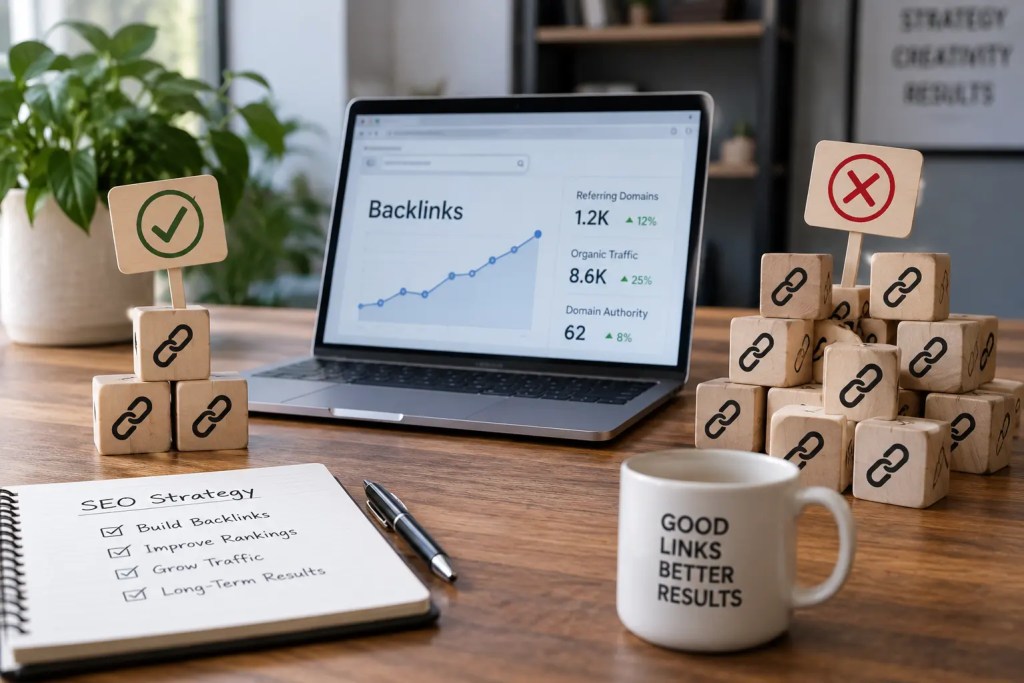
If you strip away the debate and look at what actually works in 2026, quality should lead your link building strategy, with quantity playing a supporting role. This lines up with what most SEO professionals and the Reddit community mentioned earlier seem to agree on too, that quality links from reputable, relevant sites consistently boost SEO more effectively than a flood of average ones.
That said, the best link-building quality vs quantity approach is not really about picking one extreme and ignoring the other. It is about building a backlink profile that grows steadily, leans heavily on relevance and trust, and still has enough volume to look like a genuinely active, credible website. Businesses that follow this balanced approach tend to see more stable, long-lasting results than those chasing shortcuts.
Conclusion
The best link building quality vs quantity approach is not about choosing sides in a debate for the sake of it. It is about understanding that search engines, and real readers, respond better to relevant, trustworthy links than to sheer volume. Quality should always come first, but a steadily growing quantity of good links still plays a supporting role in showing search engines that your website is active, credible, and worth ranking.
If you are building out your own strategy, start with content worth linking to, focus on relevance over numbers, and keep an eye on your backlink profile as it grows. That combination, more than any shortcut, is what actually delivers lasting SEO results.
Frequently Asked Questions
Is link building quality or quantity more important for SEO?
Quality is more important for SEO in most cases. A handful of backlinks from relevant, trusted websites tend to boost rankings far more effectively than a large number of low-quality or unrelated links. That said, a reasonable quantity of quality links still supports steady, natural growth over time.
How many backlinks do I actually need to rank well?
No fixed number guarantees rankings. What matters more is the relevance and authority of the sites linking to you. A smaller set of high-quality, relevant backlinks often outperforms a much larger set of average or spammy ones, especially for competitive keywords.
Can too many backlinks hurt my website?
Yes, if those backlinks are low quality, unnatural, or built too quickly through spammy tactics. Search engines can flag sudden, artificial spikes in link volume, which may lead to penalties or lost rankings rather than improvements.
What is considered a high quality backlink?
A high quality backlink usually comes from a site that is topically relevant to your industry, has genuine traffic, holds a good reputation, and places the link naturally within useful content rather than in a footer, sidebar, or link directory.
Do nofollow links still help with link building?
Nofollow links do not pass the same direct ranking value as followed links, but they still contribute to a natural, diverse backlink profile and can send real referral traffic. A healthy link profile usually includes a mix of both.
How long does it take to see results from link building?
Link building is a long term strategy. It can take anywhere from a few weeks to several months to see measurable ranking improvements, depending on your industry, competition, and how consistently you build quality links over time.
Should small businesses focus on local link building?
Yes, especially if they serve a specific city or region. Local directories, news sites, associations, and community websites can provide highly relevant backlinks that carry real weight for local search visibility.
